Showing posts with label SQL. Show all posts

Monday, October 14, 2013

How to Find the Hostname of a Database Server?

Some web software for a website needs the value of the hostname of a database server for it to be installed to a web server, such as WordPress (software) which needs MySQL database connection details. The MySQL database hostname will usually be "localhost" on most web hosting companies, but not always!

The name could be simply "localhost" if your database is local to your web server or to the server on your hosting provider. But if your database is external to your web server or to your hosting server, then you or your hosting provider would need to put the name of that database.

Most Hosting Providers

To be sure about your database hostname, here we will going to find the exact hostname of MySQL server through the application called phpMyAdmin, version 4.0.5:

  1. First, log in to your control panel.
  2. Find the PHP application "phpMyAdmin":
    The Application 'phpMyAdmin' on the Home of cPanel
    • On the Databases heading section if you're using cPanel.
    • Or on the Advanced Features heading section if you're using DirectAdmin Web Control Panel.
    And then click it to run that application.
  3. And in phpMyAdmin, the value of the item "Server" on the top of the user interface, is your database hostname.
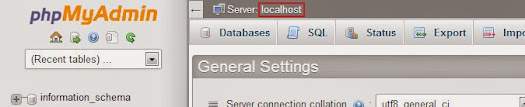
    The Database Hostname on the Application Interface of phpMyAdmin Version 4.0.5

Sunday, March 31, 2013

Used for Retrieving Data, Query Languages

A computer language that's often used on Database Management System (DBMS) and by other artificial language for querying a database or information system, is not a programming language but a query language. A query language is important to a server-side programmer, such as PHP(: Hypertext Preprocessor) developers, because it is a way to get the information that intended for a specific user, into a database. There are classifications of query languages like other computer language, and the popular three for the Web, of them are listed below, base on their popularity:

  1. SQL, pronounced not as a word on My Sequel (MySQL) but as just exact as its letter names "S-Q-L", which is short for Structured Query Language and sometimes mistakenly referred as a programming language, instead of a well known class of a database query language for accessing and manipulating relational databases that items are organized in a set of tables, in which item can have relation to another item that's into another table.
    Let Say We've Relational Database Tables:
    - Customers - Orders
    ID Name
    01 Mark
    02 Anthony
    ID No
    01 18495
    02 82796
    Sample of SQL Queries on Database:
    SELECT Customers . Name AS `Customer` , Orders . No AS `Order No.`
    FROM Customers
    INNER JOIN Orders ON Customers . ID = Orders . ID
    ORDER BY Customers . Name
    SQL Queries' Sample Result:
    Customer Order No.
    Anthony 82796
    Mark 18495
    • MySQL is the most used brand of a free Relational Database Management System (RDBMS) which administering by phpMyAdmin a free web database management for RDBMS. A relational database can be called as a server for storing sensitive data items. Most relational databases are administers by database managements.
      • Generally, a relational database is administering by a database management such phpMyAdmin for MySQL, which can perform various tasks like creating, modifying or deleting a database, table, field or a row, browsing, exporting or operating a table, running SQL query or searching data and more!
  2. XPath, the XML Path Language, is a declarative language which is one of the 3 parts of Extensible Stylesheet Language (XSL), used to select nodes from an XML document, and also used by XML Pointer Language (XPointer) to link hyperlinks in XML document to the specific parts of another XML document, and used by XQuery which is built on XPath expressions.